Recently in my consultation room, I have been seeing a recurring pattern among my clients, a pattern I experienced myself not too long ago. You know the feeling: you wake up, look in the mirror, and notice a strange, dry patch on your eyelid, or perhaps a persistent redness along your jawline or near your lips.
You haven’t changed your diet. Your skincare routine is the same high-quality regimen it has always been. You haven’t introduced any new detergents. So, what is going on?
As women in our 30s and 40s, our skin becomes more communicative. It tells us when something is wrong, and often, the answer is hiding in the one place we least expect: our makeup bag.
A few weeks ago, I noticed a dry, slightly flaky patch on my own eyelid. My first thought? “It’s the heating season; the air is just too dry.” I analysed everything—my diet, my latest serum, even my laundry pods. Everything was consistent.
It wasn’t until I did a “deep dive” into my vanity drawer that I found the culprit. It was a beautiful cream eyeshadow I used occasionally. It smelled fine. The texture hadn’t changed. But when I checked the back, I realized it was long past its prime.
From the Consultation Room
In my years of clinical practice, I’ve found that women are incredibly diligent about their SPF and night creams, but we often treat colour cosmetics as “forever products.” I once had a client with chronic redness on her cheeks that she treated as rosacea for months. It turned out to be a three-year-old blush harbouring bacteria. Once we cleared out her makeup bag and restored her skin barrier, the “rosacea” vanished within two weeks.
Decoding the PAO Symbol: Why “Looking Fine” Isn’t Enough
Most colour cosmetics feature a specific icon: the PAO (Period After Opening) symbol. It looks like a tiny open jar with a number and the letter “M” (e.g., 6M, 12M). This tells you exactly how many months the product is safe to use after you’ve first opened it.
The Chemistry of Stability
Even if a product hasn’t changed its scent or consistency, its chemical stability might be compromised. Over time:
- Preservatives break down: They can no longer fight off fungal or bacterial growth.
- Active ingredients oxidize: This can turn a once-nurturing formula into a pro-inflammatory irritant.
- Emulsifiers fail: This leads to microscopic separation that can disrupt the delicate balance of your skin.
The Invisible Transfer: Microbiome and Makeup Hygiene
Our skin is a living ecosystem populated by a unique microbiome—a collection of beneficial bacteria, fungi, and natural oils (sebum). Every time you use a wand, brush, or sponge and then dip it back into the product, you are performing a “cross-contamination dance.”
The Breeding Ground in Your Brushes
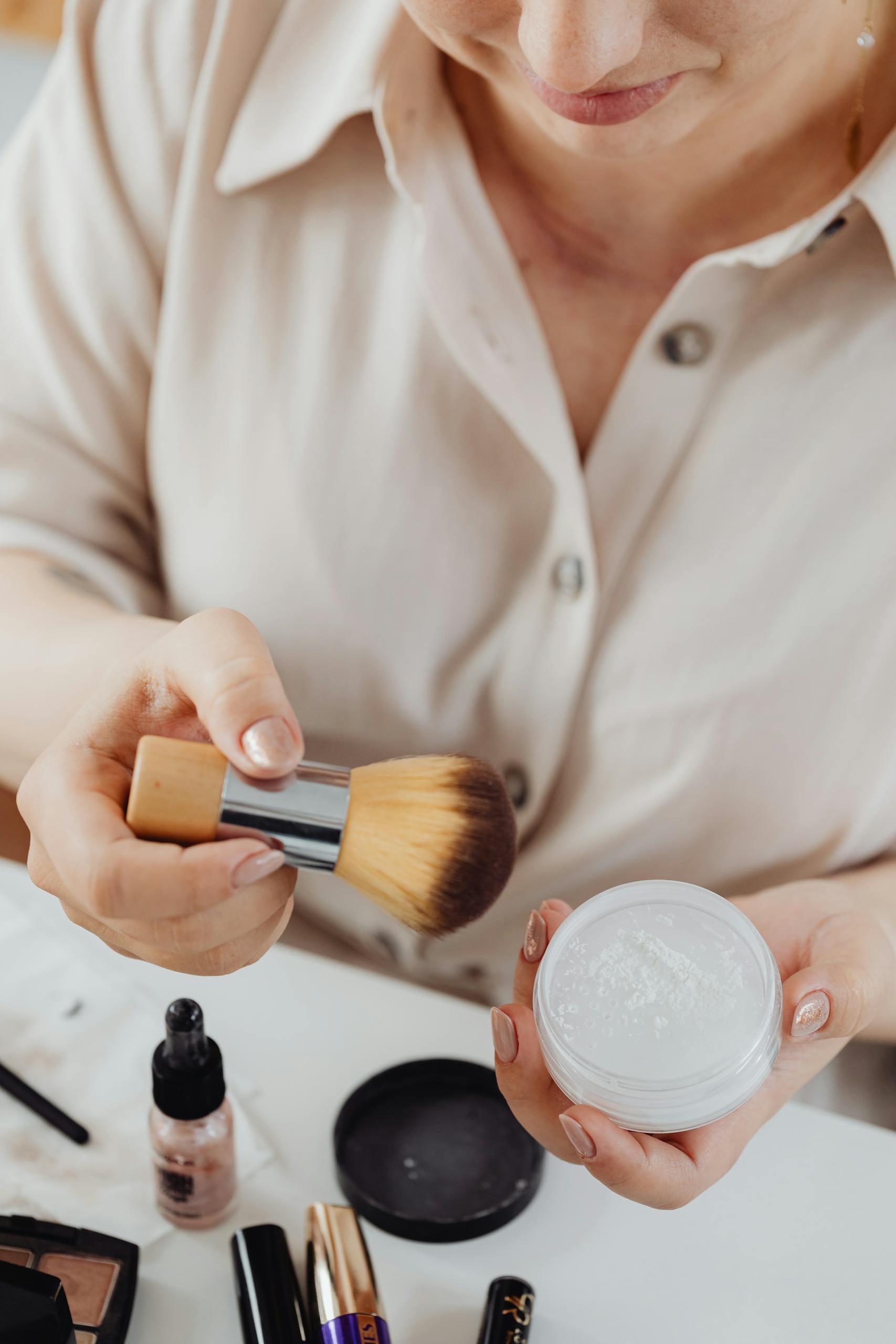
Think of your makeup sponges and brushes as a warm, dark, and often damp environment—the perfect “buffet” for bacteria. If not washed regularly, these tools accumulate dead skin cells and sebum, which then fester in the product container. This is often why we see localized inflammation. It’s not your whole face reacting; it’s just the specific area where you applied the contaminated product.
Beyond Allergies: Understanding the Hydrolipid Barrier
When we see redness, we often jump to the conclusion: “I’m allergic.” However, the reality is often a localized disruption of the hydrolipid barrier.
Your skin barrier is like a brick wall where the skin cells are the bricks and the lipids (fats) are the mortar. Using expired or bacteria-laden products “eats away” at this mortar in specific spots. The result?
- Localized dehydration.
- Visible “scales” or flaking.
- Micro-inflammations that look like red islands on your skin.
Scientific Insight: Research published in the Journal of Applied Microbiology has highlighted that a staggering percentage of used makeup products, particularly beauty blenders and mascaras, contain pathogenic bacteria such as Staphylococcus aureus and Escherichia coli. These aren’t just “dirty”; they are biologically active threats to your skin’s health.
The Steroid Trap: Why Self-Medication Can Backfire
I understand the temptation. You have an important meeting, your eyelid is red and itchy, and you reach for an over-the-counter steroid cream. Please, stop.
If the irritation is caused by bacteria or a broken barrier, steroids can actually mask the symptoms while thinning the skin and making the underlying infection worse. Instead of healing, you might be creating a cycle of dependency and further sensitivity.
What to do instead?
- Audit your makeup: Be honest with yourself. If you don’t remember when you bought it, it’s time for it to go.
- Wash your tools: Brushes should be cleaned at least once a week; sponges after every use.
- Simplify: Focus on ceramide-rich creams to rebuild that “mortar” in your skin barrier.
FAQ: Your Most Common Concerns
Q: My eyeshadow is expensive and still looks perfect. Do I really have to throw it away? A: I know it hurts, especially with high-end palettes! But the risk of a persistent skin infection or permanent sensitivity far outweighs the cost of a new product. Think of it as an investment in your health.
Q: Can I “sanitize” old makeup? A: You can spray the top layer of powders with 70% isopropyl alcohol, but this won’t help cream products or liquids where bacteria thrive throughout the formula.
Q: How do I know if my barrier is broken or if it’s just dry skin? A: Dry skin lacks oil; a broken barrier feels “tight,” stings when you apply simple moisturizers, and often shows localized redness that doesn’t go away with just any lotion.
Ready to Restore Your Glow?
If your skin is sending you signals, and you’re tired of guessing what’s wrong, let’s take a professional look together.
Is your skin acting up and you need a tailored plan? Book your holistic skin consultation and let’s get your complexion back to its radiant, healthy state.
📩 Send a DM or contact me through my website to get started.